A Listening Walk for Following One Sound
A listening walk for following one sound makes an ordinary route feel newly detailed, with simple ways to choose a sound and follow it gently.
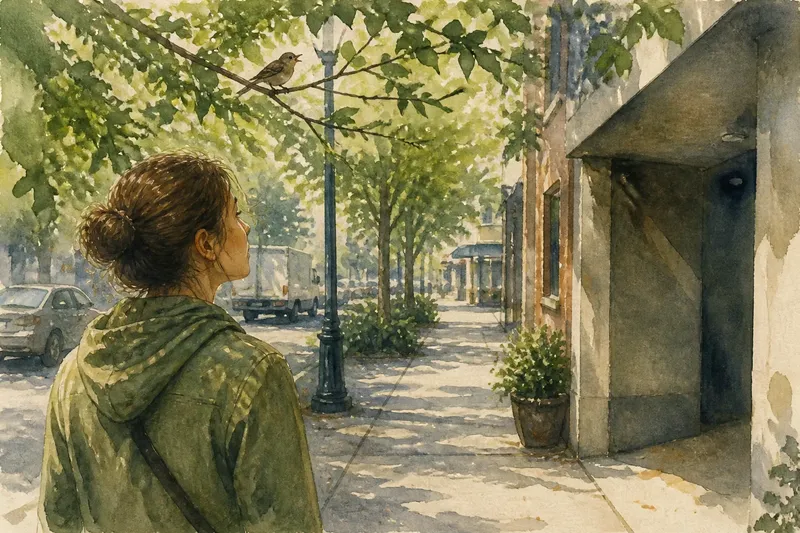
You step onto the sidewalk and hear a dry, fluttering rattle from somewhere above the parked cars. A listening walk for following one sound begins there: choose one sound already present, then notice how it changes as you move. The aim is not to find music in the street or identify every source. It is to give one strand of the everyday soundscape your attention for a while.
This can be done on a familiar block, a park path, or a courtyard where you can walk without rushing. Keep your eyes on your route and your attention available for other people, traffic, and changing conditions. Think of the chosen sound as a loose thread, not a trail you must chase. If it disappears, you can let it go.
Choose a listening approach
There are three useful ways to shape the walk. Each asks for a different kind of attention, and none requires a special soundtrack, headphones, or a destination beyond the route you already planned.
- Follow a recurring sound. Choose something that returns: a bird call, the click of a pedestrian signal, a gate swinging, or shoes crossing a hard surface. This suits listeners who like patterns. Notice the gaps between appearances and whether the sound seems nearer, farther away, clearer, or partly covered each time it returns.
- Follow a changing sound. Choose a sound that shifts as you move, such as wind moving through leaves, water running along a curb, or the rumble of vehicles passing behind buildings. This suits listeners who enjoy texture and gradual change. Attend to how its loudness, pitch, roughness, or apparent distance alters without needing to name the source.
- Follow a sound by location. Choose a sound tied to a place you pass, such as a fountain in a small plaza or the hum near a ventilation grille. This suits someone who prefers a clear boundary: listen as you approach, pass, and move away. The place provides a natural beginning and ending for the attention.
To choose, ask what feels easiest today. If you want a clear recurring marker, take the first approach. If you would rather notice continuous change, choose the second. If your attention feels scattered, a sound attached to one place can offer a simple arc. The choice is only a starting point; you can switch if the sound becomes hard to hear or stops being interesting.
Set a gentle boundary
Pick a route you already know or can walk comfortably, and leave enough attention for crossing streets and noticing what is around you. The exercise works best as a modest adjustment to an ordinary walk, not as a mission to locate a hidden source. You do not need to close your eyes, stop in the middle of a path, or use a recording app.
Choose a loose limit before you begin: perhaps listen until the next turn, through one stretch of path, or until you reach a familiar landmark. A boundary helps prevent the exercise from becoming an endless search. If you reach it while the sound is still present, you can keep listening if it feels natural; if not, let the walk continue normally.
Say you are walking through a leafy residential lane and hear a repeated, high chirp. You decide to follow it only as far as the corner shop, noticing that it sounds sharp in the open lane and softer beneath a covered entrance. At the corner, a delivery truck drowns it out. You do not need to locate the bird or wait for silence; the useful observation is how the chirp met different surroundings along your route.
Track sound, not source
Try separating what you hear from what you think caused it. A sound might seem thin, hollow, pulsing, grainy, distant, or intermittent. Those words describe listening, not an identification. Source guessing can be enjoyable, but it can also pull attention away from the changing sound itself.
Notice a few dimensions as they arise:
- Texture: Is the sound smooth, rattling, airy, metallic, or rough?
- Shape: Does it arrive in bursts, repeat evenly, swell, or fade?
- Position: Does it seem to come from ahead, beside you, above, or behind a barrier?
- Relationship: Does it stand alone, overlap another sound, or vanish under a louder one?
You do not have to monitor every quality. Pick one or two that catch your attention and stay with them. Like following a moving shadow on the pavement, you are observing how something changes as you move, not trying to pin it down.
What changes the sound?
A sound may seem different because you moved, because its source changed, or because another sound came between it and you. Buildings, fences, tree cover, open pavement, and passing vehicles can all alter what reaches your ears. You may not know which factor matters most, and you do not need to solve it to notice the shift.
Walking creates its own changes, too. Your steps can mask a quiet sound; slowing down or pausing in a safe place may make it easier to hear again. A gust of wind can blur softer details. If the sound becomes difficult to follow, treat that as part of the walk rather than a failure. You can return to it when it reappears, or choose another sound that is already present.
Keep the route comfortable and the volume natural. Avoid moving closer to roads, equipment, private property, or unfamiliar areas just to hear more clearly. If you need to concentrate on navigation or surroundings, release the listening task. The exercise should fit around the walk’s ordinary demands.
Which sound should you follow?
What if several sounds compete?
Choose the one that is easiest to notice without straining, not necessarily the loudest. If two sounds keep drawing your attention, follow whichever returns or changes in a way you find more interesting, and let the other remain part of the background.
Should you identify the source?
You can, but identification is optional. First notice the sound’s qualities and how they shift; a name can come later, and guessing is not the point of the exercise.
What if the sound disappears?
Give it a moment while continuing safely, but do not search beyond your route or force it to return. You can switch to a different sound already nearby, or simply finish the walk without following one.
Can you listen with a friend?
Yes, if you agree to follow the same sound or quietly choose separate ones. Compare what each person noticed afterward, such as a change in texture or distance, rather than treating one account as the correct version.
End without a score
At the end of your chosen stretch, take a moment to notice what remains: perhaps the sound is gone, perhaps it continues behind you, or perhaps another sound has taken its place. There is no need to rate how well you listened or remember every detail. If you want to keep one observation, make it plain: “The rattle grew softer near the trees,” or “The call returned after the bus passed.”
A listening walk for following one sound is useful precisely because the sound does not have to become a song, a clue, or a lesson. You are giving a small piece of the surroundings room to unfold while staying part of the place you are walking through. Next time, choose a different kind of sound—or leave your attention unassigned and see what meets you.